Growing your first $100,000 can feel overwhelming. Maybe you’re wondering whether you should buy stocks, invest in ETFs, contribute more to your 401(k), or simply keep saving cash. You’re not alone. Millions of Americans want to invest but hesitate because they fear making expensive mistakes.
The good news is that building wealth doesn’t require predicting the stock market or finding the next big company. Instead, it starts with consistent investing, a diversified portfolio, and enough patience to let compound interest do its work.
Whether you’re 22 and just starting your career, raising a family in your 30s, or catching up on retirement savings in your 40s or 50s, this guide explains how to build a $100,000 investment portfolio step by step using practical strategies that have stood the test of time.
You’ll also learn how to choose the right investment accounts, avoid common beginner mistakes, understand diversification, and create a portfolio designed for long-term financial independence.
Important: Investing always involves risk. Past performance doesn’t guarantee future returns. The examples in this guide are educational and shouldn’t be considered personalized financial advice.
How to Build a $100,000 Investment Portfolio
Quick Answer
The fastest and most reliable way to build a $100,000 investment portfolio is to invest consistently in diversified, low-cost index funds or ETFs through tax-advantaged accounts like a 401(k) or Roth IRA. Combine regular monthly contributions, a long-term investment strategy, and disciplined investing while avoiding high-interest debt and emotional decisions.
Key Takeaways
✅ Start investing as early as possible to maximize compound interest.
✅ Choose tax-advantaged accounts before using a taxable brokerage account.
✅ Diversify your investments instead of trying to pick winning stocks.
✅ Invest consistently through dollar-cost averaging.
✅ Rebalance your portfolio periodically to maintain your target asset allocation.
✅ Avoid chasing market trends or trying to time the market.
✅ Focus on long-term wealth building instead of short-term market movements.
Why Your First $100,000 Is the Hardest Milestone
Quick Answer
For most investors, earning the first $100,000 requires the greatest effort because every dollar comes primarily from savings rather than investment growth. However, once your portfolio reaches six figures, compound interest begins generating a much larger share of future wealth.
Many successful investors have described the first $100,000 as the most difficult milestone—not because it has magical investment powers, but because it represents the point where your money starts working almost as hard as you do.
In the beginning, your portfolio depends heavily on your monthly contributions. Every paycheck matters. Every extra dollar invested moves you closer to your goal.
However, after your investments grow larger, market returns can contribute thousands of dollars each year. Consequently, your wealth may begin growing faster even if you don’t increase your monthly investment.
Imagine pushing a heavy flywheel. The first few rotations take tremendous effort. Once the wheel gains momentum, keeping it moving becomes much easier. Building an investment portfolio works in much the same way.
Did You Know?
Investors who stay invested through market ups and downs have historically achieved better long-term results than those who frequently buy and sell based on emotions. Although markets experience short-term declines, diversified portfolios have generally rewarded patient investors over long periods.
The Power of Compound Interest
Quick Answer
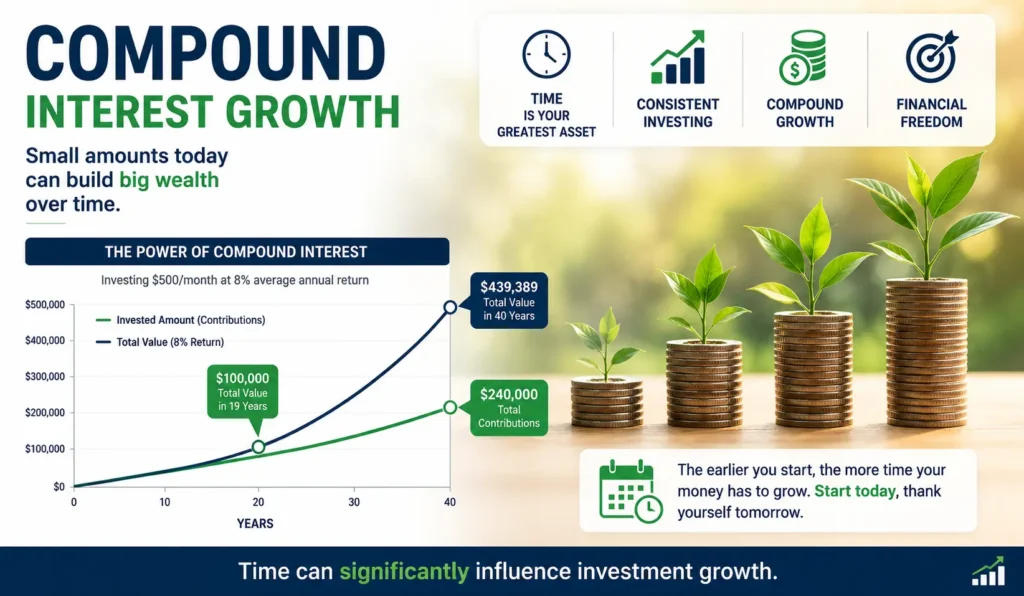
Compound interest allows your investment earnings to generate additional earnings over time. Therefore, the longer your money remains invested, the greater its potential to grow.
Albert Einstein is often credited with calling compound interest the “eighth wonder of the world.” Whether or not he actually said it, the concept remains one of the most powerful forces in personal finance.
Here’s how it works.
Suppose Sarah invests $500 every month beginning at age 25. If her investments earn an average annual return of 8% over several decades, her portfolio may grow dramatically because each year’s gains remain invested and continue earning returns.
Meanwhile, someone who waits ten years before investing often needs to contribute much more each month to reach the same financial goal.
The biggest advantage isn’t earning higher returns.
Instead, it’s giving your investments more time.
Example
| Investor | Starting Age | Monthly Investment | Time Invested |
|---|---|---|---|
| Sarah | 25 | $500 | 35 Years |
| Michael | 35 | $500 | 25 Years |
Although both investors contribute consistently, Sarah benefits from an additional decade of compound growth.
Expert Tip
Focus on increasing your savings rate before trying to increase investment returns. Saving an extra $200 every month often has a larger long-term impact than chasing investments with slightly higher expected returns.
Why Most Americans Never Reach $100,000
Quick Answer
Many people struggle to reach a $100,000 investment portfolio because they delay investing, carry high-interest debt, spend more as income rises, or react emotionally during market downturns.
Reaching six figures isn’t impossible. Yet many investors unknowingly create obstacles that slow their progress.
Some postpone investing because they believe they need thousands of dollars to begin. Others become discouraged after seeing temporary market losses and sell at the worst possible time.
Lifestyle inflation also plays a major role. As salaries increase, spending often increases just as quickly. Consequently, little money remains available for investing.
Another common mistake is keeping excessive cash in low-interest savings accounts for many years. While emergency savings are essential, investing money intended for long-term goals can provide greater growth potential over time.
Common Reasons Investors Fall Behind
| Challenge | Long-Term Impact |
| Delaying investing | Less time for compound growth |
| High-interest debt | Reduces available cash flow |
| Emotional investing | Buying high and selling low |
| Poor diversification | Higher portfolio risk |
| Lifestyle inflation | Lower investment contributions |
Common Mistake
Waiting until you “know enough” before investing often delays wealth building by years. Learning while investing small amounts is usually more effective than waiting for the perfect moment.
What Happens After Your First $100K
Quick Answer
Once your portfolio reaches $100,000, investment returns may begin contributing more to your wealth than your monthly deposits. Therefore, maintaining discipline becomes even more valuable.
Many investors notice an important psychological shift after reaching their first six-figure portfolio.
Instead of asking, “How much can I save this month?” they begin asking, “How can I protect and grow what I’ve already built?”
For example, a portfolio worth $100,000 that earns a hypothetical 8% annual return could grow by about $8,000 over a year before additional contributions. As your portfolio grows larger, investment gains may eventually exceed your annual savings.
This doesn’t mean investing becomes easier emotionally. Market declines also become larger in dollar terms. A 10% market drop on a $10,000 portfolio feels very different from a 10% decline on a $500,000 portfolio.
Nevertheless, investors who stay focused on their long-term investment strategy rather than short-term headlines are often better positioned to benefit from future market recoveries.
Did You Know?
Many long-term investors discover that the second $100,000 often arrives faster than the first—not because markets guarantee higher returns, but because larger portfolios have greater potential to benefit from compound growth.
By now, you understand why the first $100,000 investment portfolio is such an important milestone. More importantly, you’ve learned that success doesn’t come from finding the perfect stock. Instead, it comes from investing consistently, staying diversified, and allowing time to work in your favor.
In the next part, we’ll build the foundation for your investment journey by covering:
- Step 1 — Set Clear Financial Goals
- Step 2 — Build an Emergency Fund
- Step 3 — Eliminate High-Interest Debt
- Step 4 — Decide Your Investment Time Horizon
You’ll also learn how each decision shapes your long-term investment strategy and increases your chances of reaching a $100,000 portfolio with confidence.
How to Build a $100,000 Investment Portfolio Step by Step
Before you choose investments, you need a solid financial foundation. The best way to build a $100,000 investment portfolio is to set clear goals, establish an emergency fund, pay off high-interest debt, and match your investments to your time horizon. These steps reduce risk and help you stay invested through market ups and downs.
Step 1 — Set Clear Financial Goals
Quick Answer
Your financial goals determine how much you should invest, where you should invest, and how much risk you can comfortably take.
Many beginners start investing without a destination in mind. However, investing without goals is like taking a road trip without knowing where you’re going.
Instead, define exactly what you’re investing for.
Common financial goals include:
- Retirement
- Buying a home
- Children’s education
- Financial independence
- Building passive income
- Starting a business
- Early retirement
Each goal has a different timeline, which affects your investment strategy.
Example
Emma is 27 years old.
She wants to retire by age 60.
Instead of keeping all her money in a savings account, she contributes:
- 10% to her 401(k)
- Maximum affordable amount to a Roth IRA
- Additional savings into a brokerage account
Because she has over 30 years before retirement, she can invest primarily in diversified stock ETFs.
SMART Goal Example
Instead of saying:
❌ “I want to become rich.”
Write:
✅ “I want to build a $100,000 investment portfolio within 10 years by investing $650 every month.”
This goal is:
| SMART Element | Example |
|---|---|
| Specific | Build $100,000 |
| Measurable | Track monthly contributions |
| Achievable | Based on current income |
| Relevant | Supports retirement |
| Time-bound | 10 years |
Step 2 — Build an Emergency Fund
Quick Answer
Before investing aggressively, build an emergency fund covering three to six months of essential living expenses. This helps prevent selling investments during unexpected financial emergencies.
Life is unpredictable.
A job loss, medical bill, major car repair, or home expense can happen at any time.
Without emergency savings, many investors are forced to sell investments during market declines.
That’s one of the biggest wealth-destroying mistakes.
How Much Should You Save?
| Situation | Recommended Emergency Fund |
| Stable job | 3 months of expenses |
| Variable income | 6 months |
| Self-employed | 6–12 months |
| Single-income family | 6–12 months |
Where Should You Keep It?
Good options include:
- High-yield savings account
- Money market account
- Short-term Treasury funds
Avoid investing emergency money in stocks because markets can decline just when you need the cash.
Example
David has:
- Monthly expenses: $4,000
Emergency fund target:
$4,000 × 6 = $24,000
Once he reaches that amount, he directs new savings toward long-term investing.
Common Mistake
Investing every dollar while keeping no emergency savings may force you to sell investments during a market downturn.
Step 3 — Eliminate High-Interest Debt
Quick Answer
Paying off high-interest debt often provides a better guaranteed return than investing because it eliminates expensive interest charges.
Not all debt is bad.
A low-interest mortgage may fit into a long-term financial plan.
However, high-interest debt can severely limit your ability to build wealth.
Priority Debt
| Debt Type | Priority |
| Credit cards | Very High |
| Payday loans | Highest |
| Personal loans (high interest) | High |
| Auto loan | Medium |
| Student loan | Depends on interest rate |
| Mortgage | Lower priority |
Suppose your credit card charges 24% interest.
Finding an investment that consistently earns more than 24% annually is unrealistic.
Therefore, paying off that debt first is often the smarter financial decision.
Debt Avalanche vs Debt Snowball
| Strategy | Best For |
| Avalanche | Saving the most money on interest |
| Snowball | Building motivation through quick wins |
Both methods work.
The best strategy is the one you’ll consistently follow.
Example
Maria has:
- Credit card: $9,000 at 23%
- Student loan: $18,000 at 5%
She aggressively pays off the credit card first while making minimum payments on the student loan.
After eliminating the expensive debt, she increases her monthly investments.
Did You Know?
Eliminating a credit card charging 20% interest is like earning a risk-free 20% return because you’re avoiding future interest costs.
Step 4 — Decide Your Investment Time Horizon
Quick Answer
Your investment time horizon determines how much risk your portfolio can reasonably take. Generally, longer investment periods allow investors to accept more stock market volatility.
Time is one of the most important factors in investing.
If you need your money within two years, investing heavily in stocks may not be appropriate.
However, if retirement is 30 years away, temporary market declines become much less significant.
Time Horizon Guide
| Goal | Suggested Investments |
| Less than 3 years | Cash, Treasury Bills, CDs |
| 3–5 years | Conservative bond funds |
| 5–10 years | Balanced portfolio |
| 10–20 years | Mostly stock ETFs |
| 20+ years | Growth-focused diversified portfolio |
Example
John plans to buy a house in two years.
Emily plans to retire in 35 years.
Although both are investing, their portfolios should look very different because their timelines are different.
Choose the Best Investment Accounts Before Investing
Quick Answer
Choosing the right account can help you reduce taxes and grow your wealth faster. Many investors should prioritize tax-advantaged accounts before investing through a taxable brokerage account.
401(k)
A 401(k) is one of the most powerful retirement accounts available to U.S. employees.
Benefits include:
- Payroll deductions
- Potential employer matching
- Tax-deferred growth
- Automatic investing
- Higher annual contribution limits than IRAs
Why Employer Matching Matters
Imagine your employer matches 100% of the first 5% of your salary that you contribute.
That’s essentially free money for retirement.
Always try to contribute enough to receive the full employer match before investing elsewhere.
Roth IRA
A Roth IRA allows qualified withdrawals in retirement to be tax-free.
It’s especially attractive for:
- Young professionals
- Investors expecting higher future tax rates
- Long-term retirement investing
Advantages include:
- Tax-free qualified withdrawals
- Tax-free investment growth
- Flexible withdrawal rules for contributions
- No required minimum distributions during the owner’s lifetime (under current law)
Traditional IRA
A Traditional IRA may provide tax benefits today.
It’s often suitable if:
- You qualify for deductible contributions
- You’re currently in a higher tax bracket
- You expect lower taxes during retirement
Taxable Brokerage Account
A brokerage account offers maximum flexibility.
Advantages include:
- No contribution limits
- No early withdrawal penalties
- Wide investment selection
- Suitable after maximizing retirement accounts
However, investment earnings may be subject to taxes.
Health Savings Account (HSA)
If you’re eligible for an HSA through a qualified high-deductible health plan, it can be one of the most tax-efficient investing accounts available.
It offers:
- Tax-deductible contributions
- Tax-free investment growth
- Tax-free qualified medical withdrawals
Many financial planners consider the HSA a valuable retirement planning tool because healthcare expenses often increase later in life.
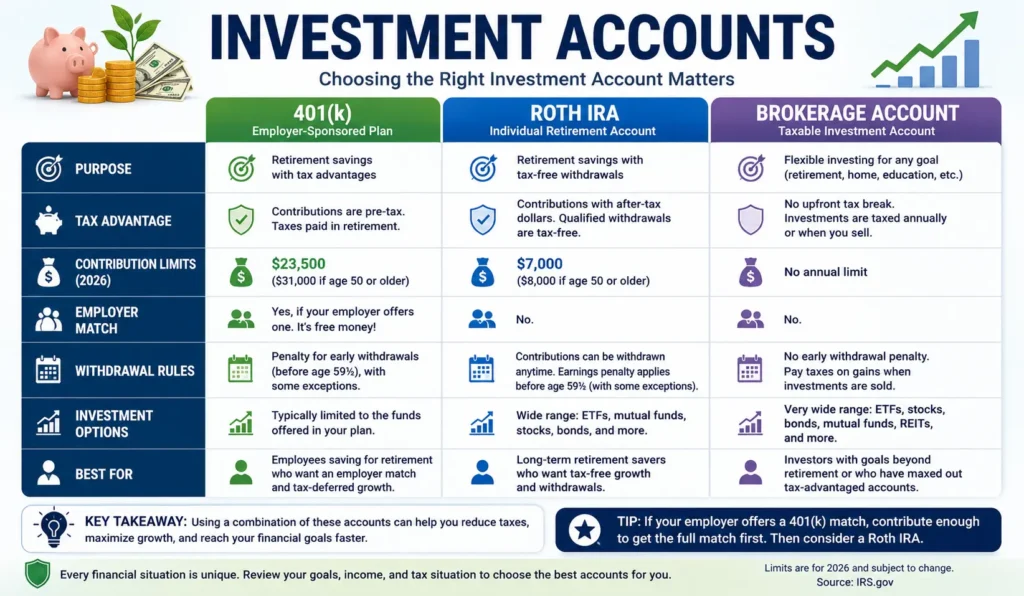
Comparison of Investment Accounts
| Account | Tax Benefit | Employer Match | Best For |
| 401(k) | Tax-deferred | Yes (if offered) | Retirement savings |
| Roth IRA | Tax-free qualified withdrawals | No | Young investors |
| Traditional IRA | Possible tax deduction | No | Tax planning |
| Brokerage Account | Taxable | No | Flexible investing |
| HSA | Triple tax advantage (if eligible) | Sometimes | Healthcare & retirement |
Suggested Account Priority for Beginners
| Priority | Account |
| 1 | Emergency Fund |
| 2 | 401(k) up to employer match |
| 3 | Pay off high-interest debt |
| 4 | Max Roth IRA (if eligible) |
| 5 | Increase 401(k) contributions |
| 6 | HSA (if eligible) |
| 7 | Taxable Brokerage Account |
2026 Update
Contribution limits and IRS rules can change each year. Before making retirement contributions, review the latest IRS guidance and your employer’s retirement plan details to confirm current limits and eligibility requirements.
Google People Also Ask
Should I invest before paying off debt?
It depends on the interest rate. Generally, high-interest debt—such as credit card balances—should be paid off first because the guaranteed savings from avoiding high interest often outweigh expected investment returns. However, if your employer offers a 401(k) match, consider contributing enough to receive the full match while paying down debt.
Can I build a $100,000 investment portfolio on an average salary?
Yes. Many investors reach this milestone by investing consistently over time rather than making large one-time investments. Regular monthly contributions, disciplined spending, and long-term investing can make a significant difference, even with a moderate income.
Is it too late to start investing at 40 or 50?
No. While starting earlier provides more time for compound growth, investors in their 40s and 50s can still build substantial portfolios by increasing savings, using tax-advantaged accounts, and maintaining a diversified investment strategy that aligns with their goals and risk tolerance.
A successful $100,000 investment portfolio begins long before you buy your first ETF or index fund. By setting clear goals, building an emergency fund, eliminating costly debt, choosing the right investment accounts, and matching your portfolio to your time horizon, you create a strong foundation for long-term wealth building.
Next in Part 3: You’ll learn how to build a diversified portfolio, choose the best ETFs for 2026, compare individual stocks with ETFs, understand dollar-cost averaging versus lump-sum investing, and explore four complete sample $100,000 portfolio allocations.
A successful $100,000 investment portfolio begins long before you buy your first ETF or index fund. By setting clear goals, building an emergency fund, eliminating costly debt, choosing the right investment accounts, and matching your portfolio to your time horizon, you create a strong foundation for long-term wealth building.
Next in Part 3: You’ll learn how to build a diversified portfolio, choose the best ETFs for 2026, compare individual stocks with ETFs, understand dollar-cost averaging versus lump-sum investing, and explore four complete sample $100,000 portfolio allocations.
Build a Diversified $100,000 Investment Portfolio
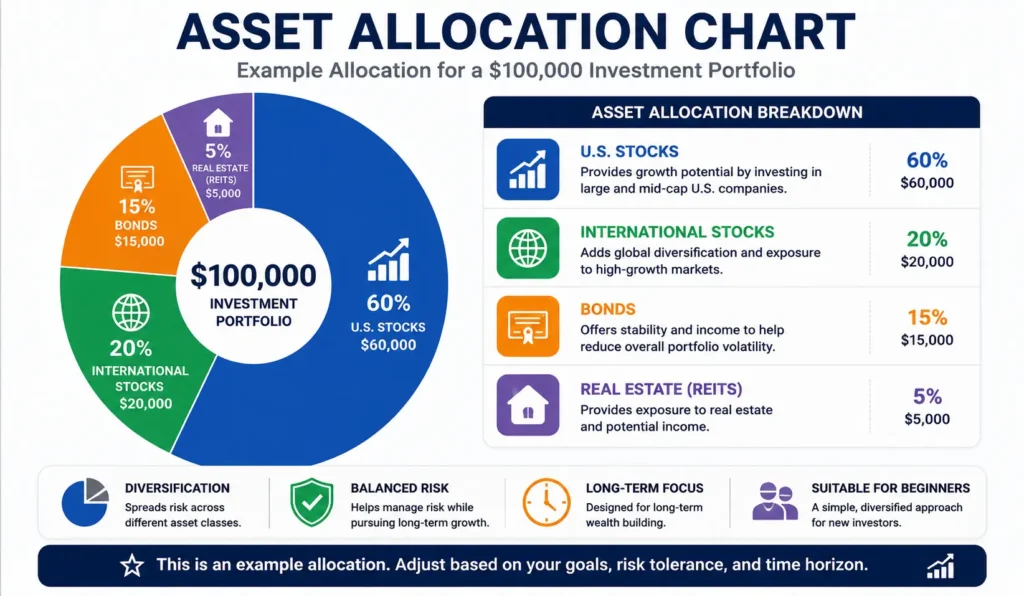
The most effective way to build a $100,000 investment portfolio is to diversify across different asset classes, industries, and regions. A diversified portfolio can help reduce risk while giving you exposure to long-term market growth.
Many beginner investors believe diversification simply means owning several stocks. However, true diversification goes much further.
A well-diversified portfolio spreads investments across:
- U.S. stocks
- International stocks
- Bonds
- Real Estate (REITs)
- Cash or short-term reserves
As a result, one investment performing poorly may be offset by stronger performance in another area.
Remember, diversification doesn’t eliminate investment risk. Instead, it helps reduce the impact of any single investment on your overall portfolio.
Did You Know?
Studies have shown that asset allocation often has a greater influence on long-term portfolio performance than trying to pick individual winning stocks.
Why Asset Allocation Matters
Quick Answer
Asset allocation is the process of deciding how much of your portfolio to invest in stocks, bonds, cash, and other assets. It should match your goals, time horizon, and comfort with risk.
Think of your portfolio like a balanced diet.
You wouldn’t eat only one type of food every day. Likewise, investing all your money in one stock or one asset class increases risk.
Instead, spreading your investments creates a more balanced approach.
Example Asset Classes
| Asset Class | Purpose | Risk Level |
|---|---|---|
| U.S. Stocks | Growth | High |
| International Stocks | Global diversification | Medium–High |
| Bonds | Stability and income | Medium |
| REITs | Real estate exposure | Medium |
| Cash | Liquidity | Low |
Beginner Portfolio Allocation
A balanced portfolio works well for many first-time investors.
| Asset | Allocation |
| U.S. Stock ETFs | 60% |
| International ETFs | 20% |
| Bond ETFs | 15% |
| REIT ETF | 5% |
Who Is This For?
- New investors
- Moderate risk tolerance
- Retirement investing
- Long-term wealth building
Aggressive Portfolio Allocation
If you’re young and investing for decades, you may choose a growth-oriented allocation.
| Asset | Allocation |
| U.S. Stock ETFs | 75% |
| International ETFs | 20% |
| Bonds | 5% |
Best For
- Investors under 35
- Long investment horizon
- Higher risk tolerance
- Maximum growth potential
Conservative Portfolio Allocation
Investors nearing retirement may prioritize stability.
| Asset | Allocation |
| U.S. Stocks | 40% |
| International Stocks | 20% |
| Bonds | 35% |
| Cash | 5% |
Expert Tip
Your ideal asset allocation isn’t the one with the highest expected return—it’s the one you can stick with during market declines without panic selling.
Portfolio Diversification Checklist
| Question | Yes/No |
| Do you own U.S. stocks? | □ |
| Do you own international stocks? | □ |
| Do you own bonds? | □ |
| Do you have emergency savings? | □ |
| Are your investments low-cost? | □ |
| Do you review your allocation yearly? | □ |
Best ETFs to Build a $100,000 Investment Portfolio
Quick Answer
Exchange-Traded Funds (ETFs) allow investors to own hundreds or even thousands of securities through a single investment. Therefore, they’re among the easiest ways for beginners to build a diversified portfolio.
Low-cost ETFs have become one of the most popular investment choices because they provide broad diversification and typically charge lower fees than many actively managed funds.
Below are examples of widely used ETFs. Always review a fund’s objectives, holdings, risks, and costs before investing.
ETF Comparison Table (Examples)
| ETF | Tracks | Expense Ratio* | Risk | Diversification | Best For |
| Vanguard Total Stock Market ETF (VTI) | U.S. Stocks | Low | Medium-High | Excellent | Core U.S. portfolio |
| Vanguard S&P 500 ETF (VOO) | S&P 500 | Low | Medium-High | Excellent | Long-term investing |
| iShares Core MSCI Total International Stock ETF (IXUS) | International Stocks | Low | Medium | Excellent | Global diversification |
| Vanguard Total Bond Market ETF (BND) | U.S. Bonds | Low | Lower | Excellent | Portfolio stability |
| Schwab U.S. REIT ETF (SCHH) | U.S. Real Estate | Low | Medium | Good | Real estate exposure |
*Expense ratios can change over time. Verify the latest information before investing.
What Makes a Good ETF?
Look for:
- Low expense ratios
- Broad diversification
- Strong trading liquidity
- Transparent holdings
- A long-term investment objective
Common Mistake
Many beginners buy several ETFs that own nearly the same companies. Instead, understand each fund’s holdings to avoid unnecessary overlap.
Individual Stocks vs ETFs
Quick Answer
ETFs are generally better suited for beginners because they provide instant diversification. Individual stocks may offer higher growth potential but usually involve greater risk.
Many new investors ask whether they should invest in companies like Apple, Microsoft, or Amazon instead of ETFs.
The answer depends on your experience and risk tolerance.
For most beginners, building a strong ETF foundation before buying individual stocks is a prudent strategy.
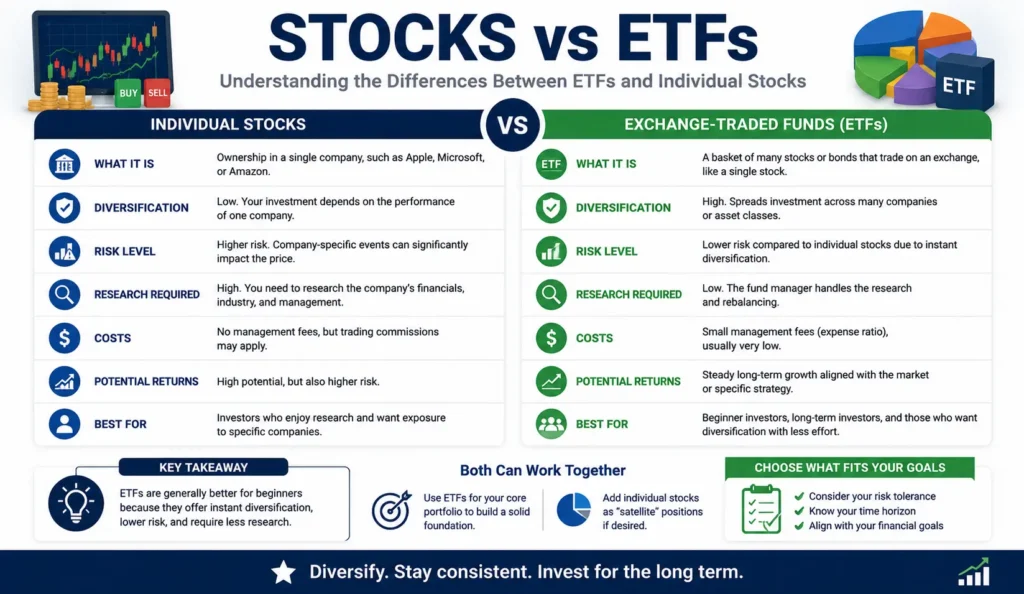
Comparison Table
| Feature | ETFs | Individual Stocks |
| Diversification | Excellent | Low |
| Risk | Lower | Higher |
| Research Required | Moderate | High |
| Time Commitment | Low | High |
| Volatility | Lower | Higher |
| Beginner Friendly | Yes | Less suitable |
Example
Suppose one company in an ETF performs poorly.
Its impact on the overall fund may be limited because the ETF holds many other companies.
However, if you own only that single stock, your portfolio could experience a much larger decline.
Expert Tip
Consider using a “core and satellite” approach. Build your core portfolio with diversified ETFs, then allocate a small percentage to carefully researched individual stocks if they align with your goals.
Dollar-Cost Averaging vs Lump Sum Investing
Quick Answer
Dollar-cost averaging means investing a fixed amount at regular intervals. Lump-sum investing means investing all available money at once. The right choice depends on your financial situation and comfort with market fluctuations.
Dollar-Cost Averaging (DCA)
With DCA, you invest consistently regardless of market conditions.
Example:
- $500 every month
- Automatic investments
- Less emotional decision-making
Benefits include:
- Builds investing discipline
- Reduces the temptation to time the market
- Fits regular paychecks
Lump-Sum Investing
A lump-sum investment means putting all available money to work immediately.
Example:
- Investing a $50,000 inheritance
- Investing proceeds from selling a business
- Rolling over a retirement account
Historically, investing earlier has often outperformed delaying investments because markets have generally risen over long periods. However, past performance does not guarantee future results.
Comparison Table
| Feature | Dollar-Cost Averaging | Lump Sum |
| Best For | Regular income | Large cash amount |
| Emotional Stress | Lower | Higher |
| Market Timing Risk | Reduced | Higher |
| Discipline | Excellent | Depends on investor |
| Automation | Easy | One-time decision |
Which Strategy Is Better?
For most workers who invest from each paycheck, dollar-cost averaging is a practical approach.
If you already have a large amount of cash to invest, lump-sum investing may be appropriate, but only if it matches your financial plan and risk tolerance.
Did You Know?
Many employer-sponsored retirement plans naturally use dollar-cost averaging because contributions are made from each paycheck.
Example $100,000 Investment Portfolios (2026)
The examples below are educational illustrations only. They are not personalized investment recommendations.
Which Strategy Is Better?
For most workers who invest from each paycheck, dollar-cost averaging is a practical approach.
If you already have a large amount of cash to invest, lump-sum investing may be appropriate, but only if it matches your financial plan and risk tolerance.
Did You Know?
Many employer-sponsored retirement plans naturally use dollar-cost averaging because contributions are made from each paycheck.
Example $100,000 Investment Portfolios (2026)
The examples below are educational illustrations only. They are not personalized investment recommendations.
Portfolio 1 – Beginner Investor
| Investment | Allocation |
| U.S. Total Market ETF | 50% |
| S&P 500 ETF | 20% |
| International ETF | 15% |
| Bond ETF | 10% |
| REIT ETF | 5% |
Best For
- First-time investors
- Moderate risk
- Long-term growth
Portfolio 2 – Young Growth Investor
| Investment | Allocation |
| U.S. Stock ETF | 65% |
| S&P 500 ETF | 15% |
| International ETF | 15% |
| REIT ETF | 5% |
Best For
- Investors in their 20s and 30s
- Long time horizon
- Higher risk tolerance
Portfolio 3 – Family Wealth Builder
| Investment | Allocation |
| U.S. Stock ETF | 45% |
| International ETF | 20% |
| Bond ETF | 25% |
| REIT ETF | 10% |
Best For
- Families
- College savings
- Balanced growth and stability
Portfolio 4 – Near Retirement
| Investment | Allocation |
| U.S. Stocks | 35% |
| International Stocks | 15% |
| Bond ETF | 40% |
| Cash | 10% |
Best For
- Investors within 10 years of retirement
- Lower risk
- Capital preservation
Investor Scenarios
Scenario 1: Alex, Age 25
Alex contributes $500 each month to a Roth IRA invested primarily in broad-market ETFs. Because retirement is decades away, Alex maintains an aggressive allocation and avoids reacting to short-term market news.
Scenario 2: Jessica and Mark, Ages 35 and 37
The couple invests through two 401(k) plans, maintains a six-month emergency fund, and adds monthly contributions to a taxable brokerage account for long-term wealth building.
Scenario 3: Robert, Age 48
Robert increased his retirement savings after paying off high-interest debt. He now uses a balanced mix of stock and bond ETFs to help manage risk while pursuing growth.
Scenario 4: Lisa, Age 58
Lisa plans to retire in seven years. She gradually shifts part of her portfolio toward bonds and cash equivalents to reduce the impact of market volatility as retirement approaches.
Google People Also Ask
Is diversification really necessary?
Yes. Diversification helps reduce the risk that one poor-performing investment will significantly harm your overall portfolio. While it doesn’t prevent losses, it can make returns more consistent over the long term.
How many ETFs should a beginner own?
Many beginners can build a well-diversified portfolio with three to five broad-market ETFs covering U.S. stocks, international stocks, bonds, and, if desired, real estate. More ETFs don’t necessarily provide better diversification.
Should I invest only in the S&P 500?
The S&P 500 provides exposure to many large U.S. companies, but adding international stocks and bonds can create a more diversified portfolio that may better align with your long-term goals.
A successful $100,000 investment portfolio isn’t built by chasing the hottest stock or predicting the next market rally. Instead, it grows through thoughtful diversification, appropriate asset allocation, disciplined investing, and the consistent use of low-cost ETFs. By choosing an allocation that matches your goals and risk tolerance, you create a portfolio designed to weather market fluctuations while pursuing long-term growth.
Coming in Part 4: You’ll learn how much you need to invest each month to reach $100,000 in 5, 10, 15, and 20 years, along with tax-smart investing strategies, portfolio rebalancing, risk management, deciding whether to hire a financial advisor, and the best investing tools available in 2026.
Monthly Investment Calculator: How Much Do You Need to Invest?
Quick Answer
The monthly amount you need to invest to build a $100,000 investment portfolio depends on your timeline and investment returns. Generally, the earlier you start, the less you need to invest each month because compound growth has more time to work.
One of the biggest questions new investors ask is:
“How much should I invest every month to reach $100,000?”
While no one can predict future market returns, you can estimate your required monthly investment using reasonable long-term assumptions.
The table below assumes an estimated 8% average annual return, which is used for educational purposes only. Actual returns will vary, and past performance does not guarantee future results.
Monthly Investment Needed to Reach $100,000
| Time to Goal | Estimated Monthly Investment* |
|---|---|
| 5 Years | ≈ $1,360 |
| 10 Years | ≈ $545 |
| 15 Years | ≈ $295 |
| 20 Years | ≈ $170 |
*Estimates assume monthly investing and an 8% annualized return. Actual results will differ.
What This Means
If you begin investing at age 25 instead of waiting until age 35, you may need to invest significantly less each month to reach the same financial goal.
Time can be one of the most valuable assets an investor has.
Did You Know?
Increasing your monthly investment by just $100 could potentially add tens of thousands of dollars to your long-term portfolio, depending on investment performance and time.
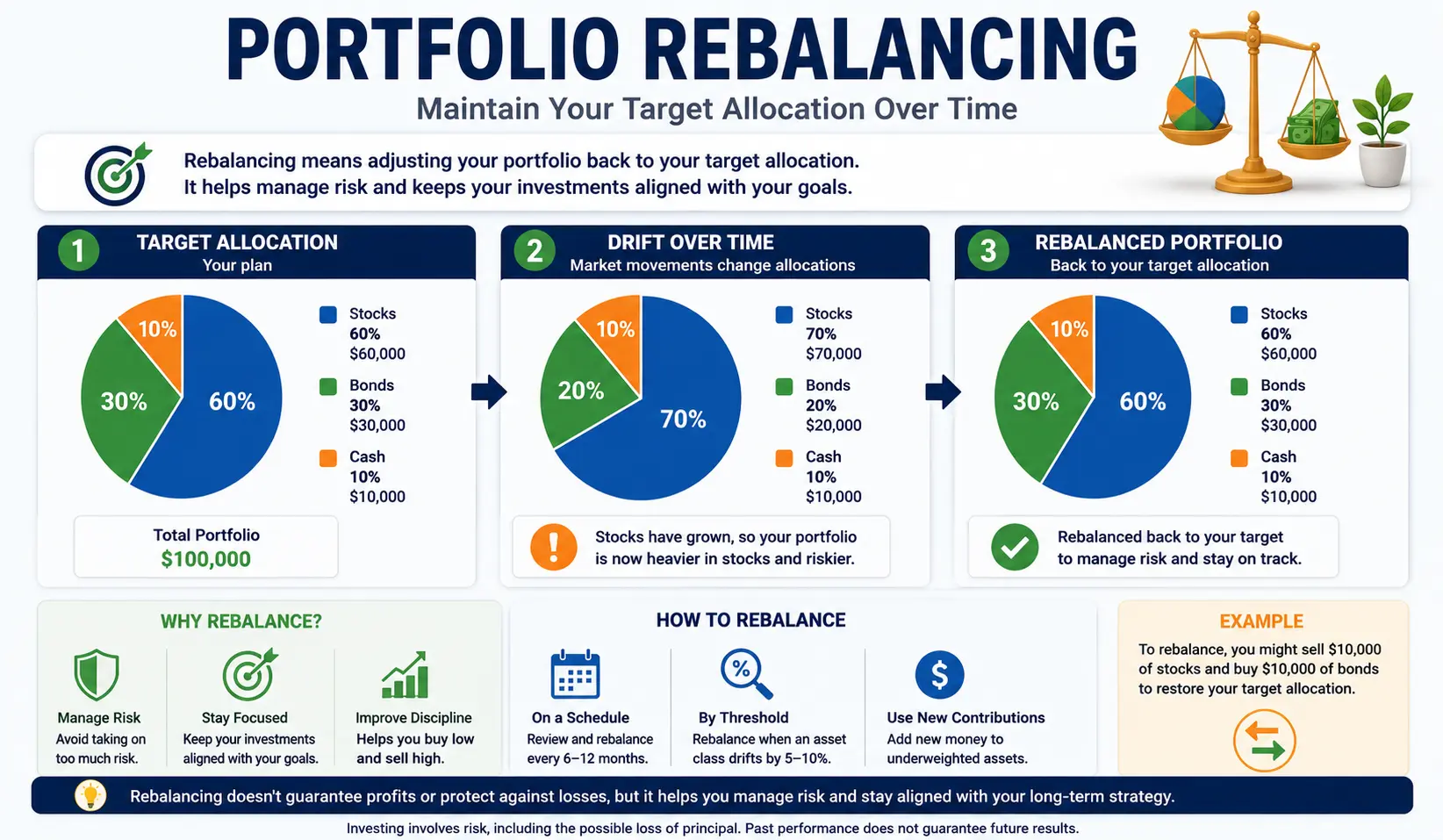
How Often Should You Rebalance Your Investment Portfolio?
Quick Answer
Most long-term investors should review and rebalance their portfolios once or twice a year, or when allocations drift significantly from their target percentages.
Markets constantly change.
Suppose your target allocation is:
- Stocks – 70%
- Bonds – 30%
After a strong stock market rally, your portfolio might become:
- Stocks – 80%
- Bonds – 20%
Although your portfolio has grown, your risk has also increased.
Rebalancing helps restore your original investment plan.
Ways to Rebalance
| Method | Description |
| Calendar Rebalancing | Review every 6–12 months |
| Threshold Rebalancing | Rebalance if an asset changes by 5–10% |
| New Contributions | Direct new money toward underweighted assets |
For many investors, adding new contributions to underrepresented investments can reduce the need to sell appreciated assets.
Tax Strategies Every Investor Should Know
Quick Answer
Using tax-efficient accounts and understanding capital gains rules can help you keep more of your investment returns over time.
Taxes can reduce your investment returns if you don’t plan ahead.
Fortunately, several strategies can improve tax efficiency.
1. Maximize Tax-Advantaged Accounts
Prioritize:
- 401(k)
- Roth IRA
- Traditional IRA
- HSA (if eligible)
These accounts may provide tax benefits depending on your circumstances.
2. Hold Investments for the Long Term
Long-term investing may qualify for more favorable tax treatment than frequent trading, depending on applicable tax laws.
3. Avoid Frequent Trading
Every sale can create taxable events in a brokerage account.
Instead, focus on long-term investing whenever possible.
4. Use Tax-Efficient ETFs
Many broad-market index ETFs tend to generate fewer taxable distributions than some actively managed mutual funds.
Tax Comparison
| Account | Tax Benefit |
| 401(k) | Tax-deferred contributions (subject to plan rules) |
| Roth IRA | Tax-free qualified withdrawals |
| Traditional IRA | Potential tax deduction |
| Brokerage Account | Taxable investment gains and income |
| HSA | Triple tax advantage (if eligible) |
Risk Management for Long-Term Investors
Quick Answer
Risk management isn’t about avoiding risk completely—it’s about taking an appropriate level of risk that matches your goals, investment timeline, and ability to stay invested during market downturns.
Every investment carries risk.
The key is managing it wisely.
Common Investment Risks
| Risk | Description |
| Market Risk | Prices fluctuate over time |
| Inflation Risk | Purchasing power declines |
| Interest Rate Risk | Bond prices may change |
| Concentration Risk | Too much invested in one asset |
| Emotional Risk | Panic buying or selling |
Five Ways to Reduce Risk
1. Diversify
Spread investments across different asset classes.
2. Invest for the Long Term
Historically, longer holding periods have reduced the impact of short-term volatility, although future results are never guaranteed.
3. Maintain an Emergency Fund
Avoid selling investments to cover unexpected expenses.
4. Invest Regularly
Dollar-cost averaging can reduce emotional decision-making.
5. Ignore Market Noise
Daily headlines often encourage emotional reactions rather than thoughtful investing.
Common Mistake
Selling investments during a market decline can lock in losses and may prevent you from participating in a future recovery.
Should You Hire a Financial Advisor?
Quick Answer
A financial advisor may be valuable if your finances are becoming more complex or if you need personalized guidance. However, many beginners can successfully invest on their own using diversified, low-cost funds and a disciplined plan.
You May Not Need an Advisor If You:
- Invest mainly in index funds or ETFs
- Have straightforward financial goals
- Enjoy learning about investing
- Can remain disciplined during market volatility
You Might Benefit From an Advisor If You:
- Own a business
- Need estate planning
- Are approaching retirement
- Have significant taxable investments
- Want comprehensive financial planning
DIY Investing vs Financial Advisor
| Feature | DIY Investing | Financial Advisor |
| Cost | Lower | Higher |
| Time Required | Moderate | Low |
| Personalized Advice | Limited | High |
| Emotional Coaching | No | Yes |
| Investment Control | Complete | Shared |
Best Tools That Help You Build a $100,000 Portfolio
Quick Answer
The right investing tools can simplify portfolio management, automate contributions, track performance, and help you stay focused on your long-term financial goals.
Portfolio Tracking Tools
| Tool Type | Purpose |
| Brokerage Dashboard | Track investments |
| Retirement Calculator | Estimate retirement savings |
| Budgeting App | Increase savings rate |
| Net Worth Tracker | Monitor wealth growth |
| Dividend Tracker | Track investment income |
Useful Categories of Investing Tools
- Retirement calculators
- Compound interest calculators
- Asset allocation calculators
- Expense tracking apps
- Tax planning software
- Portfolio rebalancing tools
Google People Also Ask
How often should I check my investment portfolio?
For most long-term investors, checking your portfolio once a month—or even quarterly—is often sufficient. Constant monitoring can lead to emotional decisions based on short-term market movements.
Can I lose money investing in ETFs?
Yes. ETFs can decline in value because they are affected by market performance. However, diversified ETFs generally carry less company-specific risk than owning a single stock.
Is investing $500 per month enough?
Yes. Investing $500 every month over many years can build substantial wealth, especially when combined with compound growth and disciplined long-term investing. The exact outcome depends on investment returns and the length of time invested.
What’s the biggest mistake new investors make?
One of the most common mistakes is trying to time the market instead of investing consistently. Emotional buying and selling can significantly reduce long-term investment success.
Building a $100,000 investment portfolio requires more than choosing good investments. It also involves understanding taxes, managing risk, rebalancing periodically, and investing consistently over time. Whether you invest $200 or $2,000 each month, disciplined habits often matter more than trying to predict the market.
2. Can I build a $100,000 investment portfolio without picking individual stocks?
Yes. In fact, many financial professionals recommend that beginners focus on low-cost index funds and ETFs instead of trying to select individual stocks. These funds provide instant diversification by investing in hundreds or even thousands of companies. Consequently, you reduce the risk associated with relying on the performance of a single business. This approach also requires less research and can make long-term investing easier to manage.
3. Is $100,000 enough to retire?
For most Americans, $100,000 alone is not enough to fund retirement. However, it represents an important financial milestone and can serve as a strong foundation for continued wealth building. Many investors use their first $100,000 as motivation to keep investing toward larger retirement goals. The amount needed for retirement depends on your lifestyle, expected expenses, healthcare costs, other income sources, and how long you expect retirement to last.
4. Should I invest every month or wait for the market to drop?
For most long-term investors, investing consistently each month through dollar-cost averaging (DCA) is often a practical strategy. Waiting for the “perfect” market opportunity can result in missing years of potential growth because no one can consistently predict market highs and lows. Therefore, regular investing can help reduce emotional decision-making and build disciplined investing habits over time.
5. What’s the safest investment for beginners?
There is no completely risk-free investment that also offers high long-term growth. However, beginners often start with broad-market index funds and ETFs, which spread investments across many companies and sectors. For short-term goals or emergency savings, high-yield savings accounts, money market accounts, or short-term Treasury securities may be more appropriate. The right choice depends on your goals, time horizon, and risk tolerance.
6. How many ETFs should I own?
Quality matters more than quantity. Many investors can create a well-diversified portfolio with three to five carefully chosen ETFs covering U.S. stocks, international stocks, bonds, and, if appropriate, real estate. Owning many similar ETFs can create unnecessary overlap without improving diversification. Instead, focus on understanding what each fund owns and how it fits within your overall investment strategy.
7. Should I keep investing during a market crash?
Historically, many long-term investors have continued investing during market declines because lower prices can allow regular contributions to purchase more shares. However, every situation is different, and you should ensure you have an adequate emergency fund before investing aggressively during volatile periods. Staying focused on your long-term plan instead of reacting emotionally has often been a key characteristic of successful investors.
8. How much of my income should I invest?
A common guideline is to invest at least 10% to 15% of your income for long-term goals such as retirement. If you start later or have ambitious financial goals, you may choose to invest a higher percentage. Nevertheless, the right amount depends on your income, living expenses, debt, and financial priorities. Increasing your contributions gradually as your income grows can make investing more manageable.
9. What’s better: a Roth IRA or a 401(k)?
Both accounts offer valuable tax advantages, and the best choice depends on your personal situation. If your employer offers a 401(k) match, contributing enough to receive the full match is often a high priority because it’s an additional employer benefit. After that, many investors contribute to a Roth IRA for tax-free qualified withdrawals in retirement, provided they meet eligibility requirements. Review current IRS rules and consider consulting a tax professional if you’re unsure.
10. Should I rebalance my portfolio every month?
Usually, no. Rebalancing too frequently may create unnecessary transactions and, in taxable accounts, potential tax consequences. Instead, many long-term investors review their portfolios once or twice each year or rebalance when allocations drift significantly from their targets. The goal is to maintain your desired level of risk rather than reacting to every market movement.
11. Can I reach $100,000 if I start investing at age 45?
Absolutely. Although starting earlier provides more time for compound growth, beginning at 45 is still worthwhile. Many investors accelerate their progress by increasing retirement contributions, reducing unnecessary expenses, paying off high-interest debt, and investing consistently. While the timeline may differ from someone who started in their 20s, disciplined investing can still help you build meaningful wealth.
12. What’s the biggest lesson successful investors share?
Many experienced investors emphasize that consistency beats perfection. Instead of trying to predict short-term market movements or chase the latest investment trend, they focus on regular contributions, diversification, low investment costs, and patience. Building wealth is typically a long-term process, and disciplined habits often matter more than making a few exceptional
Final Thoughts: Your First $100,000 Starts With the First Dollar
Building a $100,000 investment portfolio may seem like a distant goal today, but every successful investor started with a single decision: to begin.
You don’t need to earn a six-figure salary, discover the next breakthrough company, or perfectly predict the stock market. Instead, long-term success often comes from consistently applying a few proven principles:
- Invest regularly.
- Diversify wisely.
- Keep investment costs low.
- Stay invested during market volatility.
- Let compound growth work over time.
Although market declines are inevitable, they don’t have to derail your financial future. Investors who remain focused on their long-term goals are often better positioned to benefit from future recoveries than those who frequently buy and sell based on emotions.
Remember that investing isn’t about getting rich overnight. It’s about steadily building financial security, expanding your opportunities, and working toward goals that matter to you and your family.
Important Reminder: Every investor’s situation is unique. Before making significant investment decisions, consider your financial goals, risk tolerance, investment timeline, and tax situation. When needed, seek guidance from a qualified financial or tax professional.
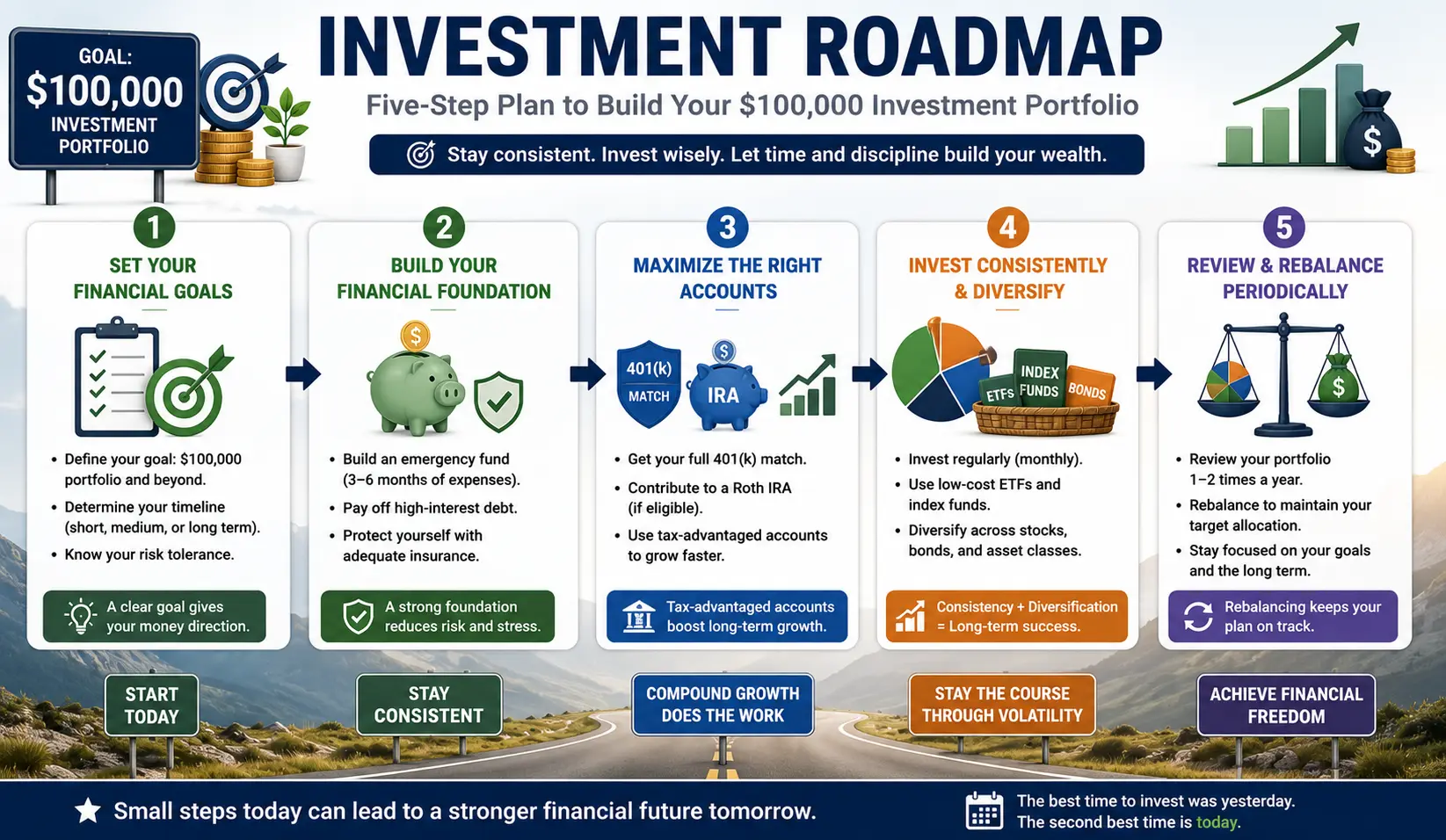
Your 5-Step Investment Roadmap
Use this roadmap as a practical starting point for your journey toward a $100,000 investment portfolio.
| Step | Action | Why It Matters |
|---|---|---|
| 1 | Define your financial goals and target timeline. | A clear goal keeps you focused and helps determine your investment strategy. |
| 2 | Build an emergency fund and pay off high-interest debt. | A strong financial foundation helps you stay invested during unexpected events. |
| 3 | Maximize tax-advantaged accounts when possible. | Accounts like a 401(k), Roth IRA, Traditional IRA, or HSA can improve long-term outcomes through tax advantages. |
| 4 | Invest consistently in diversified, low-cost ETFs or index funds. | Regular investing and diversification can reduce risk while supporting long-term growth. |
| 5 | Review and rebalance your portfolio periodically. | Maintaining your target asset allocation helps keep your portfolio aligned with your goals and risk tolerance. |
Key Takeaway
The journey to your first $100,000 investment portfolio is rarely about one perfect investment. Instead, it’s the result of hundreds of consistent decisions made over months and years. Start with what you can afford today, increase your contributions as your income grows, and remain committed to your long-term plan.
→
Your future portfolio won’t be built tomorrow—it begins with the decision you make today.
Whether you can invest $100, $250, or $500 each month, taking the first step is often the most important one. Open the right investment account, automate your contributions, stay diversified, and review your progress regularly.
By focusing on your own financial goals, maintaining an appropriate level of risk, and investing responsibly, you’ll give yourself the best opportunity to build lasting wealth over time.
Remember: Investing involves risk, including the possible loss of principal. Always invest according to your financial goals, time horizon, and personal risk tolerance.

Water Filtration Science Project: Complete Student Guide
Water Filtration Science Project A water filtration science project is a simple and interesting experiment that helps students understand how

Back to School Essay: A New Beginning for Students
Back to School Essay: A New Beginning for Students The end of summer vacation brings a special feeling to students.
Improve Credit Score Fast: 15 Proven Strategies That Really Work
How to Build a $100,000 Investment Portfolio From Scratch (2026)
Growing your first $100,000 can feel overwhelming. Maybe you’re wondering whether you should buy stocks, invest in ETFs, contribute more

Oral Cancer: Causes, Symptoms & Prevention Guide
Oral Cancer is a serious health condition, and it affects thousands of people every year. Moreover, it can develop in
Passive Income Ideas for Beginners With No Money (Start Today & Earn Smart)
Introduction Passive Income Ideas for Beginners With No Money. Everyone wants to earn money easily. However, most people think money is